Running a member-based organization means handling a lot of information every day. Between event registrations, engagement metrics, and annual dues, your data (and the upkeep required to manage it!) can quickly pile up.
If all that data is scattered across several third-party platforms, it can quickly become challenging! When this happens, you can run into administrative confusion and disjointed records.
This is where a Single Source of Truth (SSOT) comes in. An SSOT is the operational goal of maintaining one definitive, accessible, and trusted data source for your organization.
In this article, we’ll explore the challenges of scattered data and how an SSOT can be your solution. We’ll also dive into the right technology to look for when implementing the SSOT approach.
Key Takeaways
- A Single Source of Truth is a centralized system where all your organization’s data is stored, updated, and accessed consistently.
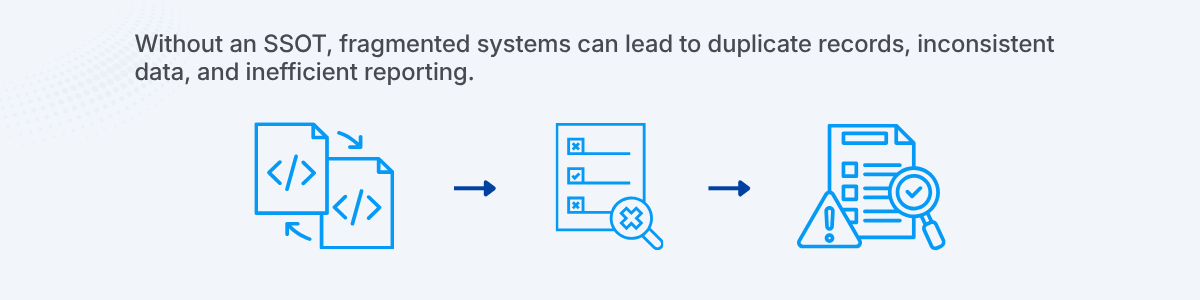
- Without an SSOT, fragmented systems can lead to duplicate records, inconsistent data, and inefficient reporting.
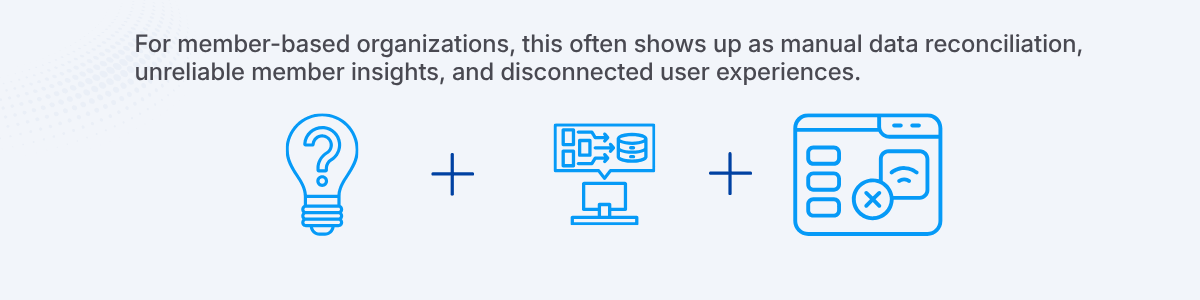
- For member-based organizations, this often shows up as manual data reconciliation, unreliable member insights, and disconnected user experiences.
- Implementing an SSOT helps reduce manual work, improve data consistency, and support more reliable reporting across events, learning, and membership systems.
- An all-in-one platform can act as an SSOT by keeping your data in a single environment, reducing the need for integrations and data syncing across tools.
How Fragmented Systems Create Data Problems
Let’s start with the root of the problem: patching data together from your events, learning, reporting, and member management platforms. Without proper integration, you may end up with scattered data, which not only slows your operations but also leaves more room for error.
For one, when data is spread so thin across platforms, the same information may appear in inconsistent formats and conflicting versions. This was one of the points Queiroz et al. (2024) discussed in their research article, “Data Value and the Search for a Single Source of Truth: What is it and Why Does it Matter?” This research reveals that without a proper SSOT approach, the information your staff relies on for critical decision-making may become outdated, duplicated, or completely untrustworthy.
In this case, you’re already dealing with bad data: any information that compromises decision-making because it is inaccurate, incomplete, invalid or biased (IBM, 2025).
The fallout from bad data creates a ripple effect across your organization’s critical operations. In Brown (2022)’s article, “A Single Source Of Truth: The Holy Grail Of Services Business Operations”, he further explains that the lack of an SSOT can hinder project management by preventing accurate coordination and alignment of resources with projects.
For example, your organization might see a massive spike in new member sign-ups and decide to increase next year’s conference budget. However, your team might later discover that those weren’t new members at all; they were just existing members who accidentally created duplicate profiles when registering for a webinar on your separate events platform!
It’s not just your staff that can run into bad data. Your members feel the fragmentation, too! For instance, a member might update their mailing address in your main member management portal, only to find that your separate event software is still pulling their old information.
Why SSOTs Matter for Associations
So, what happens when an organization implements an SSOT approach? The short answer: immediate operational clarity! An SSOT provides a reliable, standardized view of real-time data on both organizational processes and member management.
The key here is consistent data. Having one place for membership, learning, events, and engagement eliminates questions about format, reliability, and timeliness. In addition, centralized data naturally leads to faster, clearer, and (most importantly), more accurate reporting.
For example, let’s say your organization needs a comprehensive engagement report following a massive, multi-day virtual conference. Instead of spending time exporting CSV (Comma-Separated Values) files from different locations and manually reconciling data, your team can simply generate a complete dashboard with just a few clicks. And, because this is all exported from a single source, you ensure the accuracy and reliability of your data.
With a proper SSOT, your organization can reduce these manual workarounds, making it easier to build centralized reports across your systems. That gives your team a more robust foundation for tracking CE credits, membership changes, and session engagement in one reporting environment!
How a Natively All-in-One Platform Supports an SSOT
Of course, implementing an SSOT requires the right technology. After all, the benefits we discussed above are only as strong as the platform powering them. The big question now is: which one? There are many software solutions that let you implement an SSOT approach, but one of the best ones is a natively all-in-one platform!
A natively all-in-one platform (like Vocalmeet’s!) lets your critical information live in a single environment, with tools that naturally speak to each other. That’s because it’s built from the ground up as a single, modular solution that brings all your systems together in one place.
With this kind of platform, you don’t have to worry about double-entry or manual spreadsheet imports. Instead, you save time and energy while avoiding unnecessary errors! Win-win, right?
What’s more, this type of modular platform is also scalable for growing organizations. You can effortlessly start small, say, with just a learning management module, and add member management or event registration later as your needs expand.
Conclusion
Gone are the days of playing data detective. By centralizing your information (with a natively all-in-one platform, of course!), you don’t have to hunt down missing CE credits or patch together messy spreadsheets. With your data perfectly aligned, your team can finally rest easy and trust the numbers right in front of them. SSOT is the centralized approach that’s here to make your organization’s operations easier to manage.
Sources
Brown, S. (2022, November 30). A single source of truth: The holy grail of services business operations. Forbes. https://www.forbes.com/councils/forbestechcouncil/2022/11/30/a-single-source-of-truth-the-holy-grail-of-services-business-operations/
IBM. (2025, November 24). Bad data. Ibm.com. https://www.ibm.com/think/topics/bad-data
Queiroz, M., Tallon, P., & Coltman, T. (2024). Data Value and the Search for a Single Source of Truth: What is it and Why Does it Matter? Proceedings of the … Annual Hawaii International Conference on System Sciences/Proceedings of the Annual Hawaii International Conference on System Sciences. https://doi.org/10.24251/hicss.2024.795