Updated June 5, 2026
Let’s face it: no matter who you are, your schedule is probably jam-packed and chaotic. And these days, time has become a more precious commodity than ever before. Attention spans are shrinking, and traditional training methods don’t always fit into the daily lives of professionals. This is where microlearning comes in: a modern learning strategy that delivers bite-sized, focused content in short, engaging formats.
If you’re hesitant about incorporating microlearning into your member-based organization’s strategy (or aren’t sure where to start!), now is the perfect time to explore how it can help your organization.
Microlearning can be a powerful benefit for enhancing member engagement while also supporting professional development. Its flexible and accessible nature serves up valuable knowledge in small, digestible lessons, keeping learners engaged and up to date without the information overload!
Whether it’s reinforcing key industry insights, providing on-the-spot training, or boosting skill development, microlearning ensures learning happens wherever and whenever in ways that really stick!
Imagine giving your members access to quick, impactful learning experiences that fit seamlessly into their day, whether that’s between meetings, while commuting, or during a short break. By incorporating microlearning into your educational strategy, you can empower your members to develop professionally, stay up to date with industry trends, and gain even greater value from their membership.
Are you ready to transform how your organization educates and engages its members? Keep reading, and you’ll soon know all the tricks!
Key Takeaways
Microlearning helps member-based organizations deliver learning that’s easier to complete, remember, and apply.
- Enhanced engagement: Short, interactive lessons keep members focused and involved.
- Flexibility and convenience: Members can learn anytime, anywhere, and on any device.
- Cost-effectiveness: Smaller lessons are easier to create, update, and share.
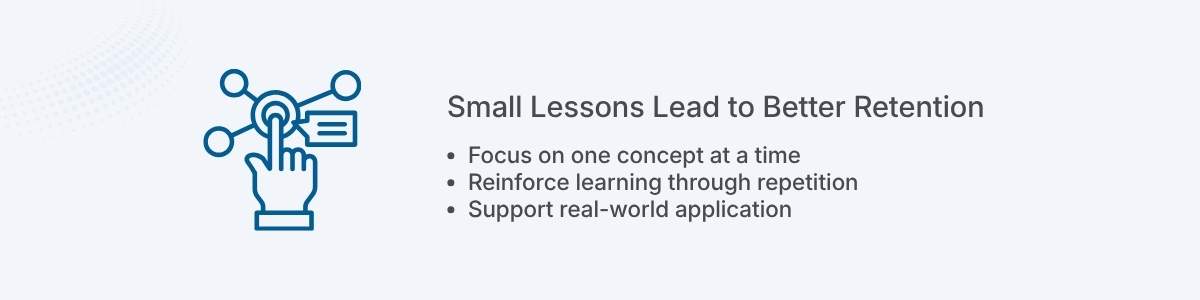
- Improved knowledge retention: Focused content and repetition help learning stick.
- Adaptability to diverse learning styles: Videos, quizzes, infographics, podcasts, and scenarios support different preferences.
- Simple implementation: Assess your members’ needs, create concise content, use the right learning platform, and iterate and improve with feedback.
What is Microlearning?
Microlearning is a modern approach to lessons that breaks down educational content into small, easy-to-digest chunks, helping learners absorb information fast.
Unlike traditional training, which can take hours, microlearning is designed to be quick, engaging, and efficient, making it easier for learners to pick up (and retain!) knowledge in a snap. It’s ideal for busy professionals in need of skills here and now, which also means it pairs well with just-in-time learning.
According to the Association for Talent Development (n.d.), many people find microlearning valuable because it can be consumed quickly while learners are on the job, unlike longer in-person or virtual training that may require them to carve out time in their work schedules.
At its core, microlearning focuses on one clear learning objective at a time, helping learners grasp and apply information without feeling overloaded. It can stand alone as a quick lesson, act as a refresher for bigger programs, or provide specific education to tackle workplace challenges exactly when needed.
Why Your Organization Needs Microlearning
In a world where every minute counts (and information overload is a real issue!), it’s crucial for organizations to be flexible and creative in order to deliver educational content that works better.
Microlearning is one of the best solutions: its bite-sized, impactful lessons can fit perfectly into even the busiest of schedules! Here’s why microlearning is a total game-changer for your organization:

1. Enhanced Engagement
Long training sessions can be a drag, sometimes leading people to tune out and lose interest. Microlearning delivers short, visually appealing content that captures and retains learners’ attention.
According to the Digital Learning Institute (2014), there is a 50% higher engagement rate with microlearning, and learners achieve a higher retention rate. The precise learning chunks and wide variety of formats benefit both the learner’s experience and the amount of information they retain by reducing the likelihood of cognitive overload.
This is consistent with Balasundaram et al. (2024)’s research, which also demonstrated microlearning’s ability to reduce cognitive overload among learners, which, in turn, allows for enhanced learning and better knowledge retention.
That’s why content like videos, quizzes, and interactive (“gamified”) modules can help encourage members to actively participate in their learning, rather than just passively consume information!
When training is engaging, members are much more likely to stick with it, retain it, and later apply it to real-world situations.

2. Flexibility and Convenience
Microlearning is designed for today’s on-the-go professionals. It allows them to learn anytime, anywhere, on any device. Now, when members have fifteen minutes between meetings or are taking a breather from their current project, they have the ability to access quick, focused learning that doesn’t disrupt their workflow.
Simanjuntak and Haris (2023) explain that microlearning offers flexibility and convenience because the modules are typically focused on a specific learning objective and can be accessed on demand.
Microlearning means members don’t have to dedicate large blocks of time to learning. Instead, they go at their own pace, making it easier to balance professional development with other daily responsibilities.

3. Cost-Effectiveness
Developing and delivering traditional training programs can be expensive and time-consuming. Microlearning, however, is more affordable to create, update, and distribute–especially when using digital platforms! Since content is delivered in smaller chunks, organizations can continuously refresh training materials without investing heavily in large-scale course redesigns.
Lower costs mean more opportunities to provide ongoing education to members while maximizing the return on investment (ROI) of training initiatives.
4. Improved Knowledge Retention
According to Clearwater (2024), people tend to forget a large portion of new information within days or even hours unless they reinforce their learning. Microlearning helps combat this by using repetition and quick, focused lessons that are easier to remember. Interactive elements like quizzes and real-world scenarios also help learners retain knowledge, ensuring that they can apply what they’ve learned when it counts.
After all, better retention leads to stronger skill development, making learning more valuable and impactful for members!

5. Adaptability to Diverse Learning Styles
Every person has a unique learning style, including your members. Some members may prefer watching videos to understand difficult concepts, while others learn best by participating in more interactive activities, and others still excel through reading and reflection. Microlearning can come in a variety of formats (such as videos, infographics, quizzes, and podcasts), which ensures that you can create content that suits every member.
Level up your member-based organization’s learning and accessibility by tapping into each of these different preferences to make your education more inclusive and effective for everyone!
How Can Your Organization Implement Microlearning?
Now that you know the benefits of microlearning, the next question is: how do you make it work? While it’s not rocket science, success comes down to having a solid game plan. Here’s how to get started:

1. Assess Member Needs
Before developing microlearning content, you’ve got to put yourself in your members’ shoes. To pull this off, take the time to gather insights through various methods such as surveys, interviews, and an analysis of past training data to identify important areas like:
- Skill gaps and professional development goals
- Preferred learning formats
- Helpful topics for their professions
By tying microlearning to the actual needs and experiences of your members, you ensure that your content is not just fun to engage with but also (and perhaps more importantly) practical and impactful.
2. Develop Quality Content
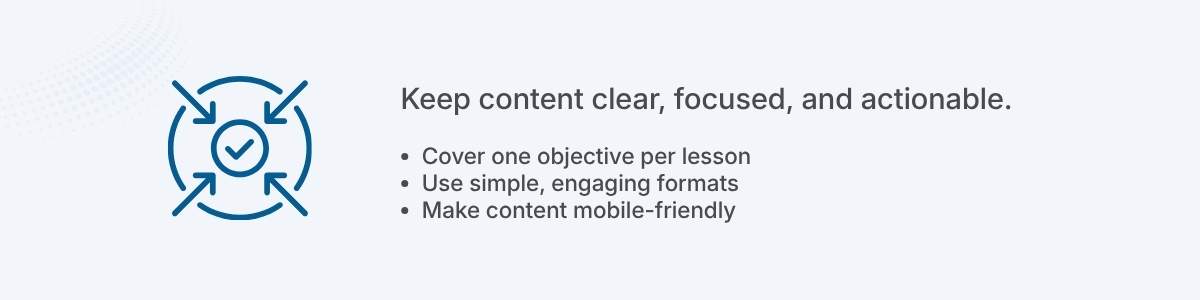
Microlearning is effective when it’s clear, concise, and engaging. Cover specific topics and focus on one learning objective per module. Consider implementing:
- Short videos to explain concepts visually
- Infographics for quick reference guides
- Scenarios and case studies for real-world application
- Quizzes and interactive elements to reinforce learning
Content should also be mobile-friendly so that members can access training anywhere–whether they’re in the office or on the go!
3. Leverage Technology
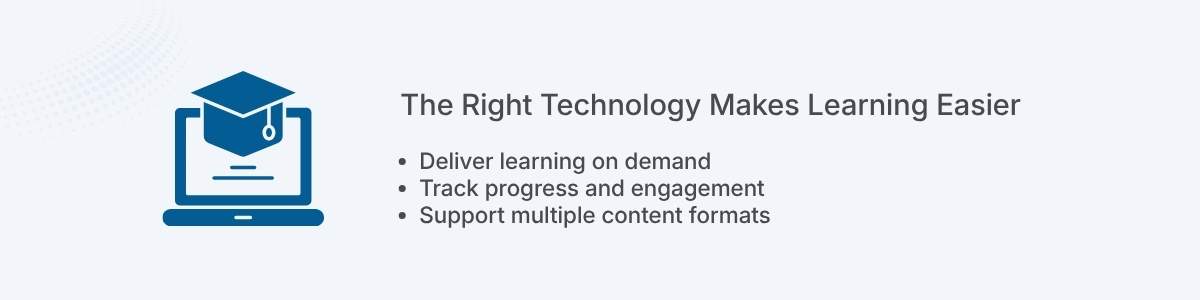
The right learning platform can make or break your microlearning strategy. When choosing a Learning Management System (LMS), look for something that:
- Supports various microlearning formats (such as videos, PDFs, SCORM files, and images)
- Can easily be used on mobile devices
- Tracks learner progress and engagement
- Allows for on-demand content delivery
Organizations can also use email campaigns, social media, or mobile apps to deliver this bite-sized learning directly to members, ensuring even easier access!

4. Gather Feedback and Improve
Continuous improvement is vital to ensuring that your members always have the highest quality learning experiences. To achieve this, all you have to do is ask and look! You can gather feedback through methods like:
- Surveys and polls
- Course analytics (such as completion rates or quiz scores)
- Discussion forums or feedback sessions
Conclusion
Microlearning can be a powerful way to engage, educate, and empower your organization’s members. By offering short, flexible, and effective learning experiences, you make sure knowledge is easy to access, remember, and use. Whether you’re boosting professional growth, getting new members up to speed, or reinforcing important ideas, microlearning keeps you relevant in a world that’s constantly changing.
Ready to transform the way your organization delivers learning? Start small, think big, and watch your members thrive!
Sources
Association for Talent Development. (n.d.). What is microlearning? Www.td.org. Retrieved May 27, 2026, from https://www.td.org/talent-development-glossary-terms/what-is-microlearning
Balasundaram, S., Mathew, J., & Nair, S. (2024). Microlearning and learning performance in higher education: A post-test control group study. Journal of Learning for Development, 11(1), 1–14. https://files.eric.ed.gov/fulltext/EJ1423546.pdf
Clearwater, L. (2024). Understanding the science behind learning retention | reports | what we think | indegene. Www.indegene.com. https://www.indegene.com/what-we-think/reports/understanding-science-behind-learning-retention
Digital Learning Institute. (2014). Microlearning & the benefits. Digital Learning Institute. https://www.digitallearninginstitute.com/blog/microlearning-the-benefits
Simanjuntak, F. P., & Haris, D. (2023). Development of digital-based learning modules using the microlearning method to improve mathematical literacy skills for 7th graders at SMP Swasta Bina Bersaudara Medan. Asian Journal of Applied Education (AJAE), 2(1), 27–48. https://doi.org/10.55927/ajae.v2i1.2788