Our CLE Top 10s of 2025

When legal professionals have access to a full online catalogue, what types of continuing legal education (CLE) courses do they typically choose?
To explore this question, we conducted an internal review of 2025 registration data from a group of Vocalmeet’s legal clients. Our aim was simple: identify which broad CLE categories and course topics attracted the most registrations in this sample, then translate those observations into practical planning ideas for the year ahead.
Note: This overview is based on aggregated data from a limited set of Vocalmeet clients and is intended for informational purposes only; it should not be relied on as legal advice or as a definitive market study.
Our Method
With Vocalmeet’s platform, clients can choose the names and number of taxonomies applied to a product (including online courses). As a result, each organization structures its catalogue differently, creating tags and categories tailored to its needs.
When it comes to broad analysis, however, we would need a consistent way to compare continuing legal education (CLE) topics across multiple clients.
Here’s the method we used to standardize and analyze the data:
1. Collected 2025 enrollment data
We reviewed CLE enrollment data from participating Vocalmeet legal clients for the 2025 calendar year.
2. Standardized course categories
We created a shared list of 20 broad categories to use across all participating clients (for example, Administrative Law, Family Law, Practice Management).
This step allowed us to compare “like with like” across organizations that use their own internal taxonomies. After all, you can’t compare apples to oranges!
3. Mapped client catalogues to the shared taxonomy
We reviewed course titles and descriptions and assigned each course to one primary category from the standardized list.
When a course could fit into more than one category, we used the primary learning objective to determine its place.
4. Ranked categories by enrollment
We calculated the total number of completed registrations for each standardized category and ranked them from highest to lowest within this sample.
5. Identified high-enrollment course themes
Separately, we looked at the individual courses with the highest total registrations.
We noted the main topic and standardized category for each to pinpoint which themes appeared most often among high-enrollment offerings; this allowed us to determine whether a popular topic did not match a top 10 category.
Please note: As this was an internal analysis, the results provide only a snapshot of a subset of clients and do not reflect a comprehensive view of the legal profession as a whole.
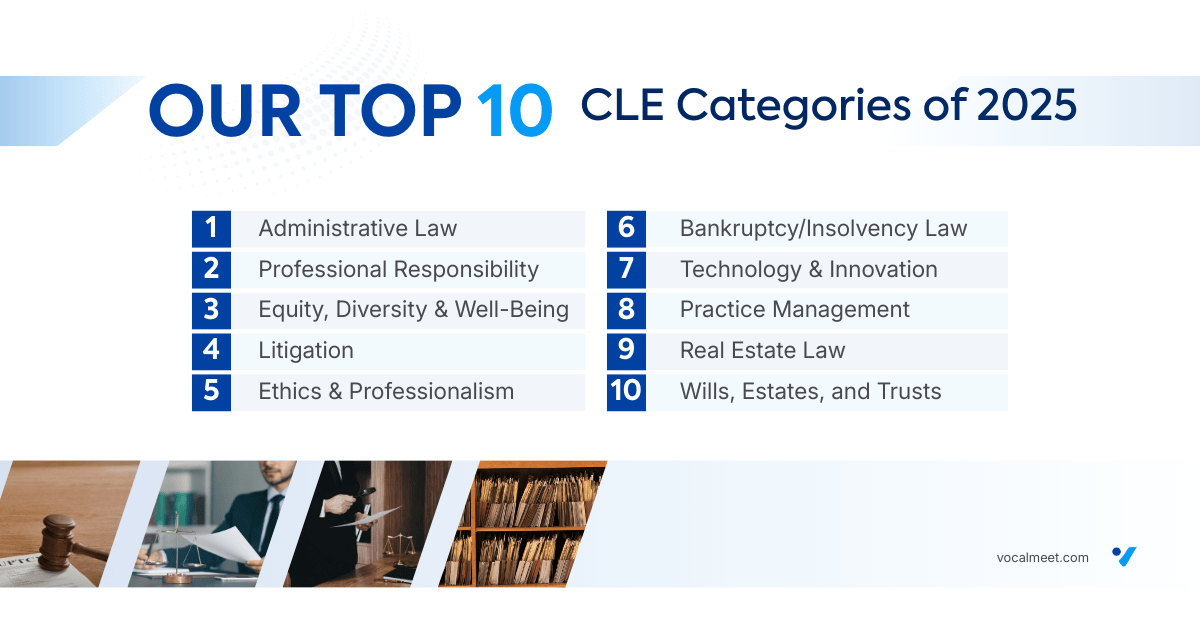
Our Top 10 CLE Categories of 2025
From most to least popular by registration:
- Administrative Law
- Professional Responsibility
- Equity, Diversity & Well-Being
- Litigation
- Ethics & Professionalism
- Bankruptcy/Insolvency Law
- Technology & Innovation
- Practice Management
- Real Estate Law
- Wills, Estates, and Trusts
- Family Law
- Criminal Law
- Alternative Dispute Resolution (ADR)
- Government Law
- Elder Law
- Constitutional Law
- Business / Corporate Law
- Employment / Labor Law
- Immigration Law
- Federal Practice
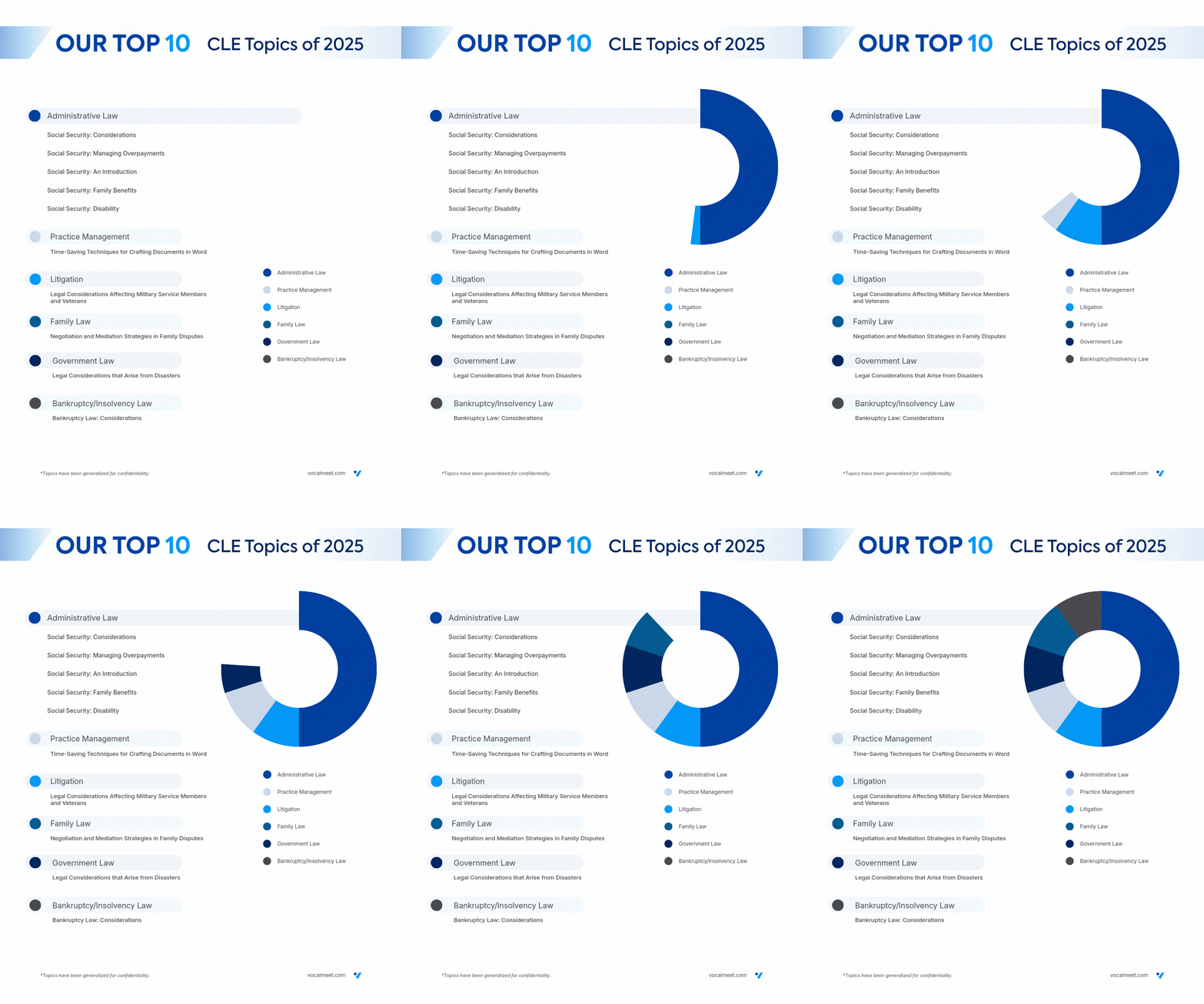
Our Top 10 CLE Topics of 2025*
From our list of most-enrolled courses, several recurring themes emerged. Below is a generalized snapshot of the kinds of topics that appeared most frequently, along with their standardized category:
- Bankruptcy Law: Considerations – Bankruptcy/Insolvency Law
- Social Security: Considerations – Administrative Law
- Social Security: Managing Overpayments – Administrative Law
- Social Security: An Introduction – Administrative Law
- Legal Considerations that Arise from Disasters – Government Law
- Social Security: Family Benefits – Administrative Law
- Social Security: Disability – Administrative Law
- Negotiation and Mediation Strategies in Family Disputes – Family Law
- Legal Considerations Affecting Military Service Members and Veterans – Litigation
- Time-Saving Techniques for Crafting Documents in Word – Practice Management
*Topics have been generalized for confidentiality.
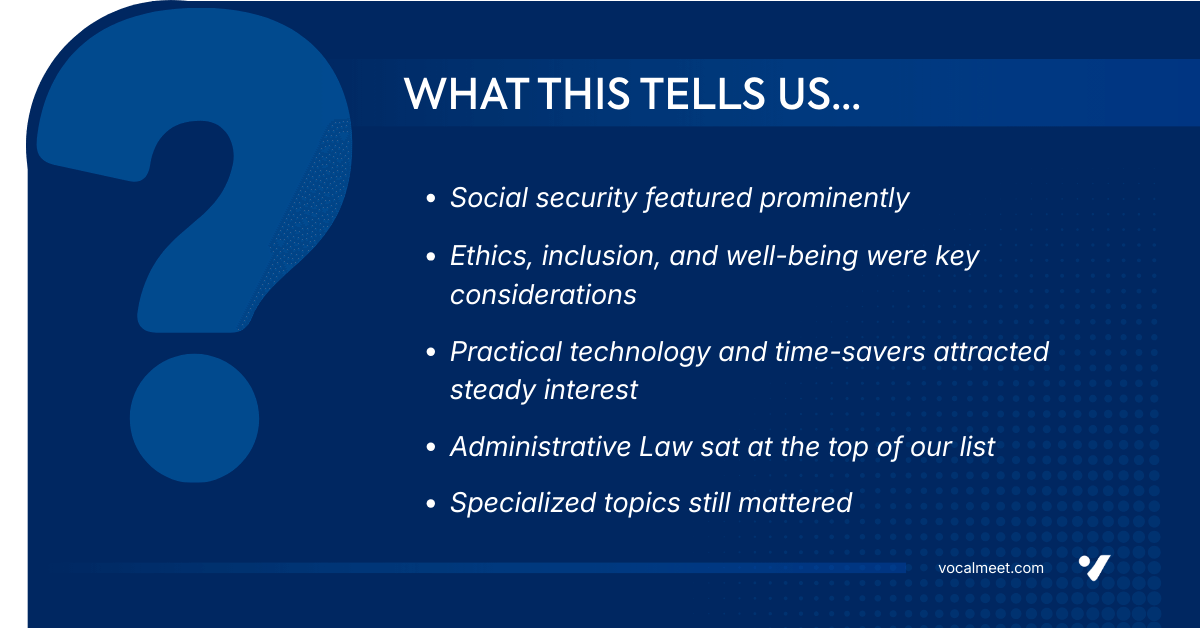
What This Tells Us
1. Social security featured prominently
Five of our top ten courses focused on social security, from introduction to specifics. This suggests an interest in practical guides on this topic, whether in an introductory course or a deep dive into a specific section or issue.
This also highlights the value of practical, “how-to” CLE series that help practitioners navigate complex topics and regulatory frameworks. An added benefit of hosting themed CLEs is that they can be grouped into course bundles with a tidy discount to encourage members to buy.
2. Ethics, inclusion, and well-being were key considerations
At the category level, Professional Responsibility, Ethics & Professionalism, and Equity, Diversity & Well-Being all appeared in our top five.
For bar associations and regulators, this underscores the importance of keeping ethics, professionalism, bias, and wellness programming current and practical.
3. Practical technology and time-savers attracted steady interest
While many high-enrollment courses in our sample dealt with complex legal subjects, we also saw strong interest in practical “how-to” courses focused on:
- Effective use of everyday tools (such as word-processing software)
- Practice management efficiencies
- Broader Technology & Innovation topics
For bar associations, these indicate a desire for CLE that helps members leverage their existing tools, improve their hard skills, and stay up to date with technology advancements and trends.
4. Administrative Law sat at the top of our list
In our dataset, Administrative Law ranked first among the standardized categories.
While this is just one sample, it’s broadly consistent with commentary highlighting in-demand fields. For instance, Donna Campbell of The National Jurist noted that labour and employment law were highly popular fields in 2025, while compliance and risk management were hard to ignore (2025).
5. Specialized topics still mattered
Only ten categories can occupy the “top 10,” but that doesn’t mean the rest are unimportant. Areas like Family Law, Criminal Law, ADR, Government Law, Elder Law, and Immigration Law continued to attract registrations.
These topics support areas of practice that are often described as “evergreen” (Campbell, 2025) and offer variety for members who have already met the core requirements. The key is balance: a strong CLE portfolio often mixes broad, high-demand topics with more specialized, high-value offerings.
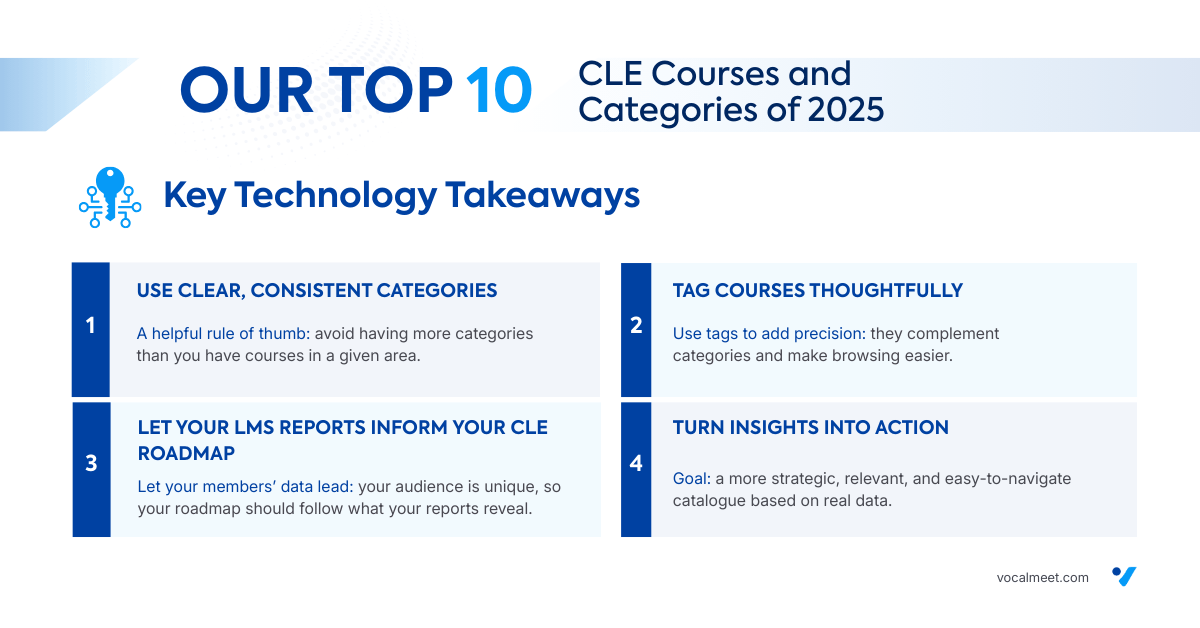
Key Technology Takeaways
Regardless of your specific course mix, how you organize and analyze your online catalogue has a significant impact on how members find content and how your team learns from the data.
1. Use Clear, Consistent Categories
A helpful rule of thumb: avoid having more categories than you have courses in a given area.
- Keep category labels clear, intuitive, and descriptive; the clearer your catalogue navigation, the easier it will be for members to find the courses that suit them best.
- Standardize your internal taxonomy as much as possible (especially if you manage multiple programs, sections, or jurisdictions).
- Review your categories periodically to remove duplicates and merge overlapping terms.
Best-practice guidance from content and taxonomy experts consistently emphasizes that well-designed taxonomies improve searchability, navigation, and reporting (Nav Thethi, 2024).
If your catalogue is cluttered with unclear or redundant categories, it becomes harder for both members and staff to see what’s working.
2. Tag Courses Thoughtfully
Categories are only one layer of wayfinding; tags help you add precision.
- Apply consistent tags for more specific themes (such as social security, attorney wellness, bias and inclusion, or artificial intelligence (AI)) as needed.
- You can then use these tags to cross-sell related programs and create niche store bundles.
This is also how you can reflect member search terms (e.g., by problem, audience, or scenario) without overexpanding your main category list.
3. Let Your LMS Reports Inform Your CLE Roadmap
You don’t need to wait for a yearly review to learn from your data. With a capable learning management system (LMS), you can:
- Generate reports by category, course, date range, and more.
- See which courses are gaining or losing traction.
- Spot patterns (such as high registration but low completion rates, which may signal a need to revise areas of course content).
Because every member base is different, your own data should guide your decisions. You can reuse our method of analysis to test which topics, formats, and series work best for your audience.
4. Turn Insights Into Action
Once you’ve identified your own high-interest areas, you might consider:
- Developing a short series around topics that attract sustained interest
- Creating course bundles that connect related themes (like wellness, professionalism, practice management, or technology)
- Featuring high-performing categories more prominently in your CLE storefront, newsletter, or social media
- Some LMSs even allow you to promote “featured courses”; you can take advantage of this capability to further boost your most popular courses.
The goal here is to use the data you collect to make your upcoming catalogue more strategic, relevant, and easy to navigate.
Conclusion
While our top 10s of 2025 provide an interesting snapshot, the real story is written in your own data. Consider:
- Which categories and topics attracted the most enrollments last year?
- Which had the most completions?
- Which formats (single course, series, bundle) performed best for your members?
By pairing these insights with clear categories, thoughtful tagging, and regular reporting, you can build a data-driven CLE roadmap that reflects the needs of your members.
So…what were your top 10 CLEs this year?

Works Cited
Campbell, D. (2025, June 9). Fastest-growing and most in-demand legal specialties in 2025. National Jurist. https://nationaljurist.com/fastest-growing-and-most-in-demand-legal-specialties-in-2025/
Nav Thethi. (2024, September 26). Master Taxonomy Management for Digital Success. CMSWire.com. https://www.cmswire.com/digital-experience/master-taxonomy-management-for-digital-success/